


Beamsplitters Selection Guide
Beamsplitters Selection Guide: Types, Applications, and Key Criteria
Beamsplitters are vital optical components in countless systems—from high-end scientific instruments to everyday imaging devices. Whether you’re designing an interferometer, fluorescence system, or beam combining setup, selecting the right beamsplitter is essential for optimal performance.
This Beamsplitters Selection Guide outlines the core types of beamsplitters, explains how they work, and provides practical advice for choosing the best one for your application.
What Is a Beamsplitter?
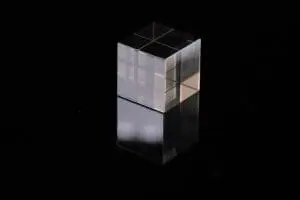
A beamsplitter is an optical device designed to divide a beam of light into two separate paths—one transmitted and one reflected. This is usually done by applying a thin-film coating on a glass substrate and angling the element relative to the incoming light. In many systems, beamsplitters can also combine two beams into one.
How Beamsplitting Works
1. Intensity-Based Beamsplitting
A partial reflective coating determines the reflection-to-transmission (R/T) ratio, such as 50:50, 70:30, or 60:40. This method is commonly used for general-purpose beam division.
2. Wavelength-Based Beamsplitting (Dichroic)
Dichroic mirrors reflect specific wavelengths and transmit others.
- Hot mirrors reflect IR light.
- Cold mirrors reflect visible light and transmit IR.
These are ideal for applications like fluorescence microscopy or thermal management.
3. Polarization-Based Beamsplitting
- Polarizing beamsplitters separate light into S- and P-polarizations.
- Non-polarizing beamsplitters (NPBS) are designed to maintain polarization state, useful in broadband applications.
Types of Beamsplitters
This guide summarizes the major form factors and their respective pros and cons.| Type | Description | Advantages | Limitations |
| Plate Beamsplitters | Flat coated optical substrates | Easy integration, low cost | Beam offset, ghost reflection |
| Cube Beamsplitters | Bonded right-angle prisms | No transmitted beam offset, durable | Higher cost, size restrictions |
| Polarizing Beamsplitters | Dielectric coating on cube or plate | Clean polarization separation | Cube preferred for broadband |
| Non-Polarizing Beamsplitters | Dielectric or hybrid coatings | Maintains polarization | Metallic coatings add absorption |
| Dichroic Mirrors | Thin-film coated plates or cubes | Sharp spectral filtering | Cube design widens transition band |
| Transmission Gratings & Polka Dots | Specialized patterned coatings | Useful for spectroscopy | Less common in standard systems |
Where Beamsplitters Are Used
Beamsplitters play an important role in many optical systems:| Application | Beamsplitter Function |
| Interferometry | Splits light to measure interference (e.g., Michelson interferometer) |
| Fluorescence Imaging | Dichroic mirrors separate excitation and emission light |
| Machine Vision | Enables coaxial illumination using plate beamsplitters |
| Sensor Protection | Cold mirrors block thermal IR to protect detectors |
| Lighting Design | Dichroic filters adjust color temperature in illumination systems |
Beamsplitters Selection Guide: Key Criteria
When selecting a beamsplitter, consider these key factors:
1. Application Purpose
Are you combining beams, dividing intensity, or separating wavelengths? This defines the starting point for your selection.
2. Spectral Requirements
Match the beamsplitter’s coating and substrate to your operational wavelength range—UV, visible, NIR, or IR.
3. Source Compatibility
- Use high-damage-threshold coatings for laser applications.
- Dielectric coatings are ideal for low-power or incoherent sources.
4. R/T Ratio
Choose based on how much light you want reflected vs. transmitted (e.g., 50:50 for equal splitting, 90:10 for diagnostics).
5. Polarization Handling
Determine if polarization must be preserved, separated, or controlled.
6. Mechanical Constraints
- Cube beamsplitters are better for compact systems.
- Plate beamsplitters offer more flexibility for open setups.
Tailored Beamsplitter Solutions from Shanghai Optics
Shanghai Optics offers a wide selection of optical beamsplitters, including:- Standard designs: Plate, cube, polarizing, non-polarizing, dichroic
- Advanced options: Hot/cold mirrors, polka dot types, and transmission gratings
- Fully customized solutions: Designed to meet unique optical, mechanical, and environmental needs
Need help?
We offer consultations and initial feasibility studies. If you have questions about limitations or lens capabilities we’re more than happy to work through your proposed custom components. As an unmatched custom optical provider, we’ll do everything that we can bring your vision to life.


